The Heat Pump Installer’s Guide to Assessing Residential Electrical Service Best practices and procedures for assessing a home’s electrical capacity prior to heat pump installation.
Electrical Service and Heat Pumps
Heat pumps often lead to increased amperage. Therefore, before installing a heat pump, it is critical to assess the home’s electric system capacity. One or more of these additional options may need to be completed. These options can add to the overall cost of the project.
To meet increased demand for heat pumps, installers may need to:
- Upgrade the electrical service amperage from the utility
- Rearrange breakers to create open breaker space in the electric panel
- Replace an outdated electrical distribution panel
- Add a subpanel
- Perform a combination of these options
What This Guide Will Do
This guide will assist HVAC installers in assessing a home’s electrical system before engaging with an electrician or starting the heat pump installation process. This guide includes steps to:
01.
Determine the home’s electrical service capacity
02.
Discuss long-term plans for the home
03.
Estimate existing and future peak electrical loads
04.
Provide options to install clean heat in electric-system-constrained homes
05.
Anticipate the electrical work

Important
At no time during your electrical assessment should the protective cover on the home’s electrical distribution panel be removed without meeting National Fire Protection Association (NFPA) 70E1, the standard for everyone working around electrical equipment, and all applicable OSHA regulations2.
Step 01:
Determine the Home’s Electrical Service Capacity (Amperage)
Every home connected to the power grid receives a specific electrical service capacity from the local utility. It is measured in amperage (amps) and based on the conductor size. Types of homes that may need more amperage to meet electrical demands of a heat pump:
| Existing Amperage/Age | Likelihood to Need an Upgrade |
|---|---|
| <100A or built prior to 1965 | Likely needs more amperage |
| 100A, 150A, 200A | Possibly needs more amperage |
| >200A | Unlikely to need more amperage |
Additionally, an upgrade to the utility service may be necessary if these situations are found:
- Older homes, typically built before 1950, with a fuse box panel which at most will have 100-amp capacity. Even with 100-amp capacity, this type of panel indicates an underserviced home that may be hiding other electrical issues.
- Apartments without shared community loads, manufactured homes, and older single-family homes built before 1965 with less than 100-amp panels.
- Newer homes with 100-amp service with no available breaker slots. Although load-sharing, tandem breakers, or a subpanel may assist with this issue, a service upgrade is best practice.
- Large homes with many electrical loads or planning additions may require more than 200-amp service.
To assess service capacity:
- Inspect the main breaker panel.
- Check the amperage on the main breaker switch.
- More than one switch in the leading breaker position? Add up the amperage.
Determining if the Home Has at Least 100-Amp Service
If you answer “no” to any of these questions, that is a sign that electrical upgrades may be necessary to accommodate an air source heat pump:
- Is the weather head* through the roof or high on the flat wall? A weather head that has been installed under a soffit or low on a flat wall could be a sign of outdated electrical service.
- Is the outside meter panel square or rectangular in shape? A round meter panel could be a sign of outdated electrical service.
- Does the electrical panel itself have a 100-amp main breaker? If there is no main breaker (or if the main breaker only has 60/70-amp capacity), that could be a sign of outdated electrical service.
A licensed electrician should always make the final assessment as well as any necessary electrical service upgrades.
*The weather head is a weatherproof service drop entry point where overhead power enters a home.

Providing Superior Service
Consider the customer’s current upgrade and ask about future electrification plans. If the customer is planning electrical upgrades such as solar panels or vehicle charging stations, it will impact the assessment.
High, Low, and Rated Capacity
If a home was built in the last 50 years, there may be electrical panels that can accommodate higher-capacity service but are wired from lower capacity. For example, an electrical panel with a 200-amp capacity may only be wired from 100-amp service. In such cases, the existing panel can stay when upgrading the service capacity, saving the homeowner replacement costs.
The rated potential capacity of the panel can be found on a sticker or tag inside the door. Alternatively, you can count the breaker spaces.
Twenty spaces indicate 100-amp rated capacity, 30 spaces indicate 150-amp rated capacity, and 40 spaces indicate 200-amps. There are 200-amp panels explicitly designed for tandem or half-space breakers.
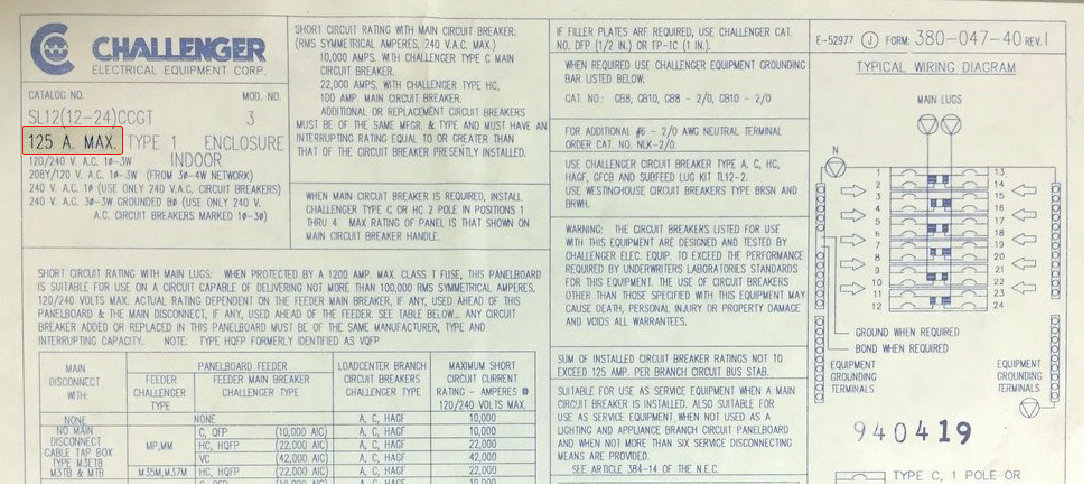
Electrical distribution panel manufacturer label with allowed max current of 125 amps highlighted.
Step 02:
Discuss the Homeowner’s Long-Term Plans
Before doing work, discuss the homeowner’s plans for upgrades and electrification over the next five to ten years.
Consider the peak electrical load of the home, especially if the homeowner is planning to:
- Purchase an electric vehicle
- Install solar panels
- Replace gas appliances with electrical ones
Current and Future Electrical Service
If the installer notices problems with the home’s current electrical system, including scorch marks around outlets, light switches that do not function as expected, lights flickering, or the lack of grounded plugs, bring these items to the homeowner’s attention. Tell the homeowner they should seriously consider having an electrician conduct a full assessment and upgrade of the electrical system.
Claim Rebates and Tax Incentives
As New York State moves toward electrification, upgraded electrical service may be eligible for upfront rebates and tax incentives and add value to the home at resale.
Think About Future Appliance Needs
A homeowner may need to replace a broken or old appliance quickly. If so, the homeowner may be reluctant to upgrade their existing electrical service. Electrical system modifications may provide options for handling the heat pump load in some of these cases.
Plan Electrical Work Strategically
It is more cost-effective in the long run to do all necessary electrical work at once. While it might lead to higher upfront costs, the homeowner will unlock greater value and peace of mind over time.
Step 03:
Estimate Existing and Future Peak Electrical Load
To determine a home’s peak electrical load:
- Examine the branch circuits and electrical loads of existing appliances throughout the house.
- Access and use an online Electrical Load Calculator3 aligned to the current NEC guidelines to sum up the existing load.
- Enter the anticipated electrical load of the planned heat pump(s) into the calculator. Depending on the heat pump size and style, it can draw up to 60-amps during startup.
- Compare the total peak load with the existing service capacity.
Assess Electrical Work for a More Accurate Project Scope
Although the project’s electrician will also perform this calculation, it can be helpful for the HVAC contractor to obtain preliminary results to guide the project scope.
Factor In All Electrical Upgrades from the Start
The tool also accepts inputs for any other electrical service upgrades, such as electric vehicle (EV) chargers. It helps assess if future electrification plans will require service upgrades.
Step 04:
Provide Options to Install Clean Heat In an Electric-System Constrained Home
A home may have sufficient electrical capacity to cover the estimated electrical load but no space for new breakers. If so, installing a sub-panel or load-sharing smart splitter installation may be a viable solution.
Active Load Management
If the estimated post-install electrical load is similar to the service capacity, there are several ways to potentially avoid a service upgrade through active load management.
Explore the following options. Learn the advantages and disadvantages of each, especially if installers and/or homeowners are unfamiliar with them.
- Load-sharing smart splitters
- Smart electrical distribution panels or smart breakers
- Low-load ENERGY STAR® electrical appliances
Smart Splitters
When electrical loads are not in constant use, a load-sharing smart splitter can reduce the maximum total electrical load on the home. A smart splitter is a device that can convert a 240-volt socket into two sockets capable of powering two devices asynchronously based on user-programmed prioritization. The splitter allows two devices to share one circuit.
The splitter allows power to one device while preventing the other device from drawing power simultaneously. Each device must have a power draw equal to or less than the associated breaker. An example of such a pairing is an electric clothes dryer and an EV charger. The load-sharing smart splitter prevents the EV charger from operating if the dryer is in use.
Energy-Efficient Appliance Upgrades
A homeowner can significantly reduce electricity usage and peak amperage by upgrading to smaller, newer appliances with ENERGY STAR® certification or eliminating unused appliances. These actions can create substantial additional electrical capacity for installing a heat pump if the new heat pump is appropriately sized to replace a heating and cooling system with a similar or higher amperage rating.
Smart Panels and Smart Breakers
A smart electrical distribution panel or smart breaker offers technology-enabled solutions for more comprehensive control of a home’s power distribution.
These types of products:
- Enable the homeowner to manage power distribution
- Focus on load management through smartphone applications
- Automatically prioritize which loads receive power and when, providing real-time response
Optimize Appliances for Electrical Capacity
Appliances such as refrigerators, clothes washers, clothes dryers, or dishwashers over 15 years old are ideal for replacement.
Removing extra refrigerators and freezers, especially those in unconditioned spaces, significantly reduces energy load.
Smart power strips for appliances with phantom loads, such as computers, cable boxes, and gaming systems, also help save energy.
Step 05:
Anticipate the Electrical Work
The image below shows the average cost for electrical and distribution panel upgrades. This is important when discussing the scope of work with the homeowner. The HVAC contractor will use this information to determine the equipment to be installed and plan for any future homeowner projects.
The electrician will be engaged in the upgrade, but their work scope will primarily be based on the information provided by the HVAC contractor.
Know Your Building Codes
HVAC contractors must know and comply with building codes, which may vary by location.
Average Costs for Upgrading Electrical Service and Distribution Panels
The costs provided are not a comprehensive list and vary by location.

Considerations for Upgrade Costs
Some costs are quite sensitive to specific aspects of the site — like the distance of underground trenching, location of the breaker panel, or proximity to the utility power supply. Consider the costs only directly relevant to your planned upgrade.
Panel Location
In some jurisdictions, new panel installations must be accessible from the home’s exterior. Exterior panels must be weather-resistant, which can increase the cost.
Age of Existing Electrical Service
Newer installations within the past 25 years may allow adding a subpanel instead of requiring an entirely new panel.
Condition of Existing Electrical Work
Worn-out wiring, damaged circuits, or receptacles must be replaced to meet building code requirements. Alternatively, a well-maintained 100-amp panel can be converted to a subpanel of a new 200-amp main panel to save on rewiring costs.
The Amperage of the New Service
Higher amperage service — such as 400 amps — requires costlier wire to upgrade, although labor costs are unaffected. Check with the utility provider for available upgrades.
Reach out to your Clean Heat Connect participating distributor for additional information about assessing the electrical service related to heat pump installations.
Go to NYSERDA’s Clean Heat Connect page4 for more information and resources on heat pump installations.
Footnote
- US Department of Energy Office of Critical Minerals and Energy Innovation. “Residential Electrical Load Calculator for the Main Service.” Building Science Education, June 10, 2022. bsesc.energy.gov/sources/residential-electrical-load-calculator-main-service.
- National Fire Protection Association. “NFPA 70E Standard Development.” NFPA, April 16, 2026. nfpa.org/codes-and-standards/nfpa-70e-standard-development/70e.
- Occupational Safety and Health Administration. “Electrical - Standards.” OSHA, accessed May 19, 2026. osha.gov/electrical/standards.
- New York State Clean Heat. “Clean Heat Connect.“ NYS Clean Heat, accessed May 19, 2026. cleanheatconnect.ny.gov.